
Littondale: The Wild Yorkshire Workshop Route I Keep Coming Back To

Littondale is one of those places people drive past without realising they’re missing some of the best scenery in the Dales. It’s steep, desolate in parts, and absolutely packed with cracking photo opportunities — often within 100 metres of where we park.
Most folks assume the big-ticket postcard spots are where the magic happens. But honestly? The off-kilter valleys like Littondale are where landscape photography suddenly “clicks”. That’s why I run a full-day workshop here every year.
What actually makes Littondale such a cracking place to learn landscape photography?
Because it gives you bonkers variety without the faff of long hikes.
You get limestone pavements, steep-sided valleys, cascades, reflections, bridges, drone-friendly viewpoints, lead-in-wall footpaths – the lot. And the daft thing is: most of it is ridiculously close to the car. So instead of spending half the day puffing up a hill, we can spend it talking composition, filters, light, and all the nuts-and-bolts stuff that actually moves the needle.
How do I structure the day so you get the maximum variety of shots?
I run an eight-hour window that flexes around sunset.
If sunset’s at 8pm, we’ll meet around 11. If sunset’s at 4pm, it’ll be an 8am kick-off. Simple, pragmatic, and it means you get the best light without feeling knackered before we’ve even started.
We begin at Linton Falls, just outside the mouth of Littondale. I’ve always loved starting here because the mix of weirs, cascades and that classic path-with-walls setup means you get early wins straight away. It’s like warming up your photographic muscles.
What can you expect at each stop — and why do I take you there?
Because every stop teaches a different skill.
Here’s the rough flow of the day:
Linton Falls – Water Movement & Easy Wins
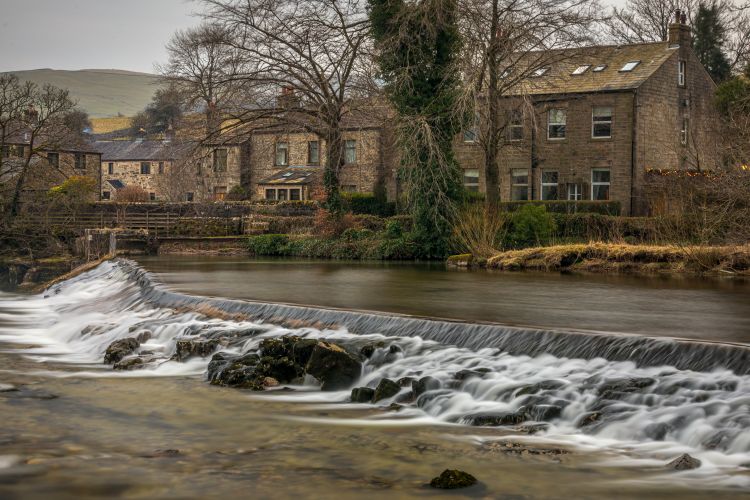
Two weirs, a hydro plant, a 100-metre diagonal weir with gorgeous cascades, and the oddly shaped Linton Falls themselves. We’ll talk shutter speeds, stability, and how to work moving water without it turning into grey mush. The path to Grassington with its two parallel walls is cracking for leading lines.
Kilnsey – Reflections & Big Structures

Kilnsey Crag is one of those places where the light just falls right. We park by the fish farm, grab a brew if needed, and work the reflections. It’s only a quick stop — 20 minutes-ish — but brilliant for nailing those chocolate-box, mirror-like shots.
Arncliffe & Cowside Valley – Depth & Valley Shapes
Arncliffe itself is proper cute, but the real gold is when we turn left and head up Cowside Beck. The valley is steep, lonely and cinematic. I usually stop a couple of times on the way up because every bend reveals summat new. If someone’s brought a drone, this is where it starts whirring away.
Halton Gill & the Bridge – Texture & Close Work

Down at the Skir Fare bridge, we hop over the wall and poke around the river. Trees, waterlines, stone textures — lots of little studies here. A great spot to slow down and learn to “see small”.
The Big Halton Gill Viewpoint – Classic Foregrounds

This is the showstopper. Limestone pavements in the foreground, a long U-shaped valley in the background sliding all the way towards Kettlewell. I usually give people 30–60 minutes here because there’s loads to practise:
- focus stacking
- foreground selection
- filtering the sky
- long-lens compression
- shooting a proper “hero shot” without it looking like every other one on Instagram
Every shot’s a winner here, which is rare in landscape work.
Pen Y Gent Gill – Shape & Light on the Hills

Here the streams gather, little waterfalls hide away, and Pen-y-Gent looms with a shape you don’t normally see. There’s a pull-in spot with limestone where we refine your composition again — same skills, different background. That repetition is what builds confidence.
Why does the sunset location change — and how do I pick the right one on the day?
Because the weather dictates everything — not some rigid plan.

If the sky is looking lively, we might push to Malham Tarn for that wide-open glow. If the valley’s holding onto some moody atmosphere, we’ll go for Winskill Stones or even the little gorge on the road where tree silhouettes catch the late light.
I’m not precious. I’ve been shooting the Dales since the early 2000s and I’ve learned this the hard way: flexibility beats any pre-planned shot list. You’ll get a better sunset by reading the sky, not a schedule.
Who is this workshop perfect for?
Anyone who wants hands-on learning without feeling daft or rushed.
You don’t need to be an expert. You don’t need a bag full of whiz-bang gear. If you’re up for a proper day out, happy to bounce around the Dales, and want real feedback instead of YouTube theory, you’ll fit right in.
What do you realistically come home with after eight hours out with me?
A huge variety of images — and a better sense of how to think like a landscape photographer.
Most people walk away with:
- moving water shots
- limestone foreground classics
- valley-wide vistas
- reflective Crag compositions
- small-texture studies around streams
- and — if we nail the weather — a tidy sunset image for the wall
And because we work steadily, you get time to try things, ask questions, fail a bit, try again… and then it suddenly clicks.
So there you go: a full day that’s part adventure, part learning, and part “How is this place not rammed with people?”
FAQ
Do I need loads of gear?
No. A camera, a tripod and a sense of curiosity.
How much walking is involved?
Short bursts, nothing too long. Most locations are near the car.
Is this suitable for beginners?
Absolutely. Half of my job on the day is coaxing people out of their shells.
What if it rains?
Welcome to Yorkshire. I adapt the route so the shots still work — texture, waterfalls, moody valleys. Rain is often a gift.
Can I bring a drone?
Yep. Some parts of the valley are brilliant for aerial work.
If you want me to tailor a version of this blog for a newsletter, landing page, or social post, just shout.